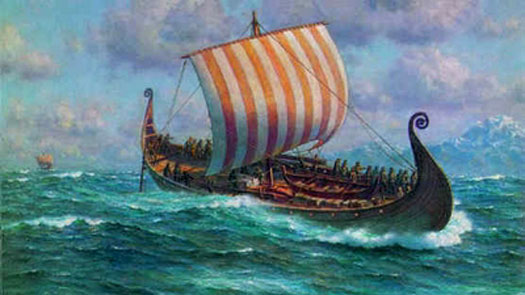
During my research into the ancestry of Nicolas Roy (1639 – 1686), my pioneering ancestor who came with his wife Jeanne Lelièvre and children to New France in 1661, I found several posts on the internet saying that they believe the Roy family line can be traced back to Viking kings of Scotland or Ireland.
The Norse kings of Dublin, Ireland have roots that extend into the Scandinavian countries from which the Vikings originated. These Viking kings were established in parts of England and Ireland by transitioning from coastal raiders to permanent settlers and urban rulers. In Ireland, they established the Kingdom of Dublin around 841 AD, while in England, they conquered several Anglo-Saxon kingdoms to establish the Danelaw and Kingdom of Jorvik (York).
To find out whether there was any evidence to support this family connection, I did a bit of research and have not found any actual documented evidence for this claim. However, I did include a section in my family history book about the possibility. The northern part of France, including Brittany and Normandy, always had a close connection with the Celts and Ango-Saxons. The Normans of France (the name Norman suggests they came from the North, or even Norway) were intermingled with the Vikings who were given feudal overlordship of areas of northern France and who ruled there from about the tenth century to 1204. It is not a surprise to me that my Canadian family has blue eyes and blond or reddish hair.
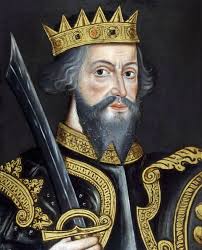
When I visited northern France in 1987 with my mother, we saw some of the artifacts linking northern France with England and Ireland. In Caen, you can visit the castle built in 1060 by William the Conqueror and see the Bayeaux Tapestry, depicting events leading up to the Battle of Hastings, where the Normans, led by William, a Norman-French king, conquered England in 1066. You can also find some 1,200 menhirs, large monolithic stones left behind by pre-Celtic people such as you can find in England.
There is still some remnant of Celtic language spoken in Brittany, similar to the Gaelic tongues spoken in Ireland and Wales. Until the French Revolution in the eighteenth century, the majority of Normans spoke a language much different than modern French today, but which can be considered Old French, and explains the difference in the French vernacular of the Québecois, the majority of whom came from northern France. The music of the region is also very similar to old Irish music. French-Canadians today enjoy playing music that sounds very similar to those old Celtic rigadoons and reels.
I wondered, based on the information I’d found leading the Roy family line to Irish nobility, whether the name Roy could refer to an actual king. At the same time, if the Roys are descended from Vikings or an Irish or Scottish king, the name Roy could have a completely different root. In Irish and Gaelic, the name Roy means ‘red.’ A famous warrior of Scotland, Rob Roy MacGregor, commonly known as Rob Roy or Raibeart Ruadh, is named for his fiery red hair. In Gaelic, the word is ruadh and is pronounced ‘roy.’ When I lived in the Netherlands, I knew several people who had the last name de Rooy, meaning ‘the red one,’ or ‘the one with red hair.’ Old Dutch and the Saxon language that became modern English are both derived from Proto-Indo-European languages and are very closely related to one another.
I don’t know if the connection to Irish kings is real or a fabrication, but I would not be surprised if my family roots extend into either Ireland or Scotland if you go back far enough. According to one family tree I found online, which doesn’t cite its sources, the line extends to Sigtrygg “Silkbeard” Olafsson, a Norse king of Dublin between 989 and 1036 AD. Of Norse and Irish ancestry, he was son of Olaf Cuarán, also known as Oláfr Sigtryggsson, king of York and Dublin.
In England, after the Norman Conquest in 1066, many Norse lords fled. In 1171, the Norse rule of Ireland officially ended when the Anglo-Norman invaders captured Dublin and killed the last Norse king, Ascall mac Ragnaill. After leaving Ireland, some descendants of Sigtrygg supposedly landed in Scotland, specifically in Blaire Atholl, Perthshire. Interestingly, Blaire Atholl means ‘field of New Ireland.’ It is located in the Scottish Highlands. The last known descendant of this Norse royal line from Ireland was supposedly Maccus de Maccwell, from whom the Scottish Maxwell clan is descended.
If a Norseman, son of this Maccus, existed and established the family name of Roy in France, then according to the information I found, this Norseman left Scotland to resettle himself in Bretagne (Brittany, France) around 1120. He would then become the first France-based ancestor on this branch of the Roy family tree and (according to this same source) his descendants lived for centuries in the district of Ille-et-Vilaine, in Brittany. There were and still are numerous families with the last name Le Roy in this area of France.
Again, our relationship to this family tree is questionable. There may indeed have been a Norse king who fled to Brittany and established a family dynasty with the last name Le Roy. But there is no evidence to show that our Nicolas Roy is related to that family. Another thing to remember is that surnames really weren’t established until much later in time. According to a historian who wrote a book on the Maxwell clan, “Permanent surnames were unknown in those early days. Territorial Lords were designated by titles of their lands, in addition to their baptismal name; but members of Celtic families had only a personal name and a to-name, not hereditary, indicative of paternity or of some peculiarity of appearance, character or occupation.” Because surnames were given randomly, if two people had the same last name, it does not necessarily mean they were related in any way.
I haven’t personally been able to discover who the grandfather of Nicolas Le Roy was. His father Louis Le Roy was born around 1607, but his life is largely undocumented. Some claim that the grandfather of Nicolas was a man named Pierre Le Roy, son of Mathurin Le Roy, who supposedly lived in St. Mâlo, which is in Ille-et-Villaine, Brittany. No paper trails have turned up to support this claim and it also doesn’t explain how Louis Le Roy ended up in Dieppe, Normandy where Nicolas was born.
If DNA test results are to be believed as an indicator of true bloodlines, my DNA test results from Ancestry have shown that I have thirteen percent Swedish and three percent Norwegian ethnicity, even though there are no family records linking me to those countries. The fact that I have DNA from those places can be explained by both my Dutch ancestors on my mother’s side and French ancestors on my father’s side, who came from Normandy. Vikings infiltrated most of western Europe over time, including the regions that are now the Netherlands and France, and I have one branch on my father’s side that links me to the Scottish Highlands, another area where Vikings came, so it wouldn’t be unusual to have a little bit of that DNA showing up.


